
Imagine

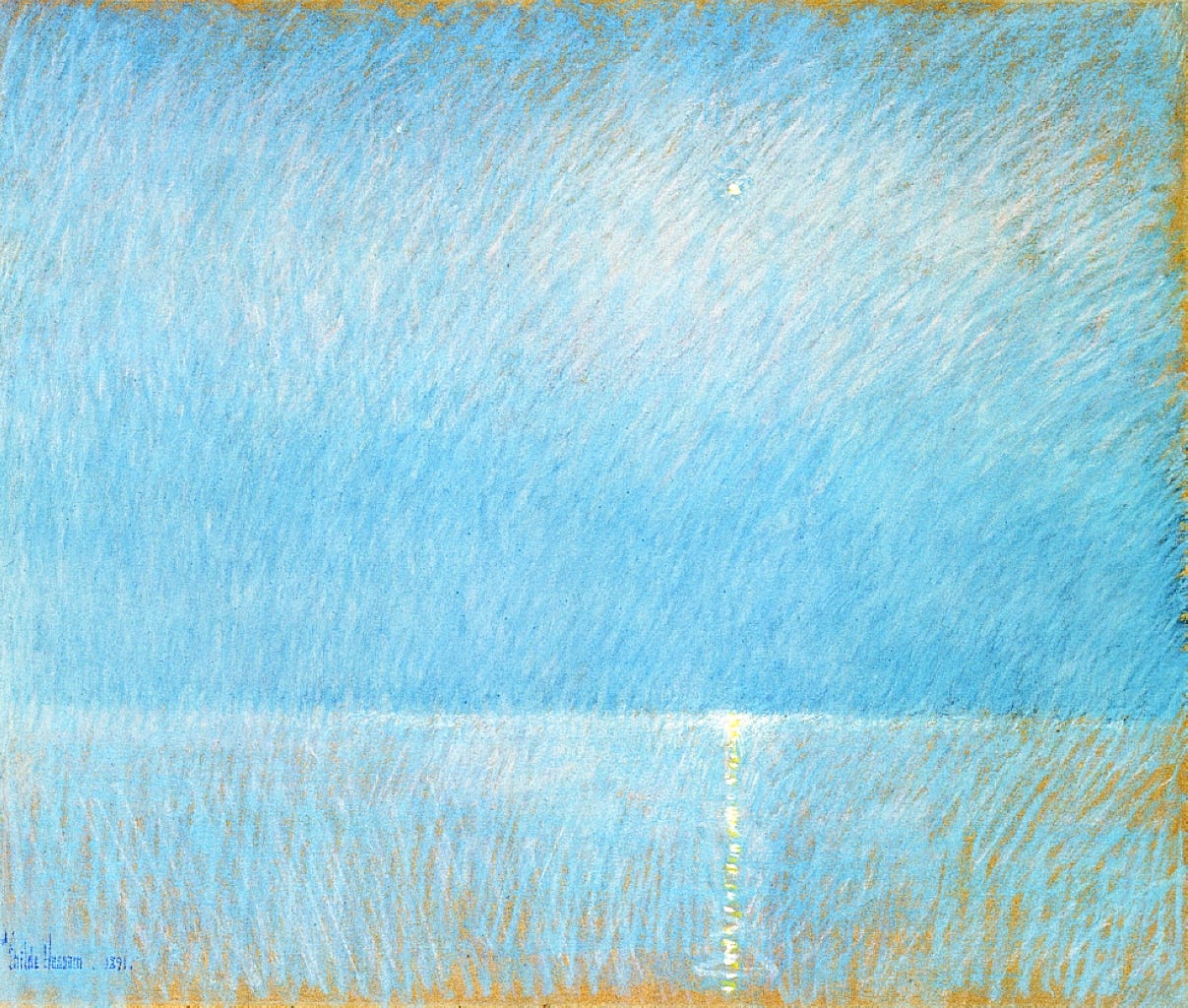
The Evening Star, Childe Hassam, 1891
O Who will show me those delights on high?
––George Herbert, From The Temple (1633)
The group headed up the mountain––Moses, Aaron’s two sons, and seventy of the elders. On any other day, they would have seen a vista of mountains and desert and Israel’s massive camp looking tiny in the vast wilderness. But on this day, they saw God. Not the face of God, they saw “a pavement of lapis lazuli” under His feet. This footstool of God was all they could bear of the glory of God and the beauty of heaven. Their view is kindling to light the fires of our imagination.
Paul tells us that since heaven will be our eternal home, we should think about it often:
“Since, then, you have been raised with Christ, set your hearts on things above, where Christ is, seated at the right hand of God. Set your minds on things above, not on earthly things. For you died, and your life is now hidden with Christ in God” (Colossians 3:1-3).
Setting our hearts and minds on things above includes contemplating the glories of heaven that Scripture points us to. As magnificent as creation is now, we can expect the new heavens and new earth to display infinite wonders. But how can we picture a beauty we know only through its earthly shadows? Phillis Wheatley’s 1773 poem “On Imagination,” personifies Imagination, who says:
Thy wondrous acts in beauteous order stand,
And all attest how potent is thine hand.
The awe inspiring complexities of our world and universe point to the fact that God brought the beauty of the worlds around us out of His infinite imagination. Created in His image, He gave us the gift of imagination. With it, we can contemplate the home Christ is preparing for us. Wheatley says we can follow imagination to find heaven and to explore the universe:
Imagination! who can sing thy force?
Or who describe the swiftness of thy course?
Soaring through air to find the bright abode,
Th' empyreal palace of the thund'ring God,
We on thy pinions can surpass the wind,
And leave the rolling universe behind:
As Wheatley demonstrates, writers join other creatives on the forefront of imagining heaven. We see it in Virgil’s Elysium vision of an afterlife. Tolkien’s Undying Lands, while more of a foretaste of heaven, is where Frodo and Gandalf go to rest from their labors until death. C.S. Lewis imagines heaven with his solid people and perfect light that is “so bright it seems to drink up shadows.” In his book Heaven, Randy Alcorn suggests we may find in heaven some of this world’s art, architecture, music, and literature that is beautiful and God-glorifying. These descriptions come from those who set their minds on heaven and imagine what it might possibly be like.
Wheatley’s poem tells us that imagination frees us, like it did for these writers, to see and take hold of what is not yet visible to the eye:
From star to star the mental optics rove,
Measure the skies, and range the realms above.
There in one view we grasp the mighty whole,
Or with new worlds amaze th' unbounded soul.
The poem continues, saying imagination has the power to change winter to spring and lead our thoughts to lofty realms.
There’s a shift, however, in the last stanza of the poem, where it finds that despite its power, Imagination has its limits:
But I reluctant leave the pleasing views,
Which Fancy dresses to delight the Muse;
Winter austere forbids me to aspire,
And northern tempests damp the rising fire;
The coldness is overpowering, and the speaker gives in. These are the closing lines:
They chill the tides of Fancy's flowing sea,
Cease then, my song, cease the unequal lay.
The poem makes a point. The present earth is still very much our reality as we live in the tension of the “now and the not yet.” But heaven is our ultimate reality, our Savior has gone to make a home for us. As we continue to contemplate it, to imagine what it might be like, our focus and treasures shift from those that are temporal to glories that will last forever.
Prayer
Jonathan Edwards:
“Let heaven be ever before my eyes.
There is my Father, my Savior, and my home.”
For further inspiration in imagining heaven, here is a poem by George Herbert written in 1633, from The Temple:
                                   Heaven.

O Who will show me those delights on high?
                                         Echo.                  I.
Thou Echo, thou art mortall, all men know.
                                         Echo.                  No.
Wert thou not born among the trees and leaves?
                                         Echo.                  Leaves.
And are there any leaves, that still abide?
                                         Echo.                  Bide.
What leaves are they? impart the matter wholly.
                                         Echo.                  Holy.
Are holy leaves the Echo then of blisse?
                                         Echo.                  Yes.
Then tell me, what is that supreme delight?
                                         Echo.                  Light.
Light to the minde: what shall the will enjoy?
                                         Echo.                  Joy.
But are there cares and businesse with the pleasure?
                                         Echo.                  Leisure.
Light, joy, and leisure; but shall they persever?
                                         Echo.                  Ever.