
The Road

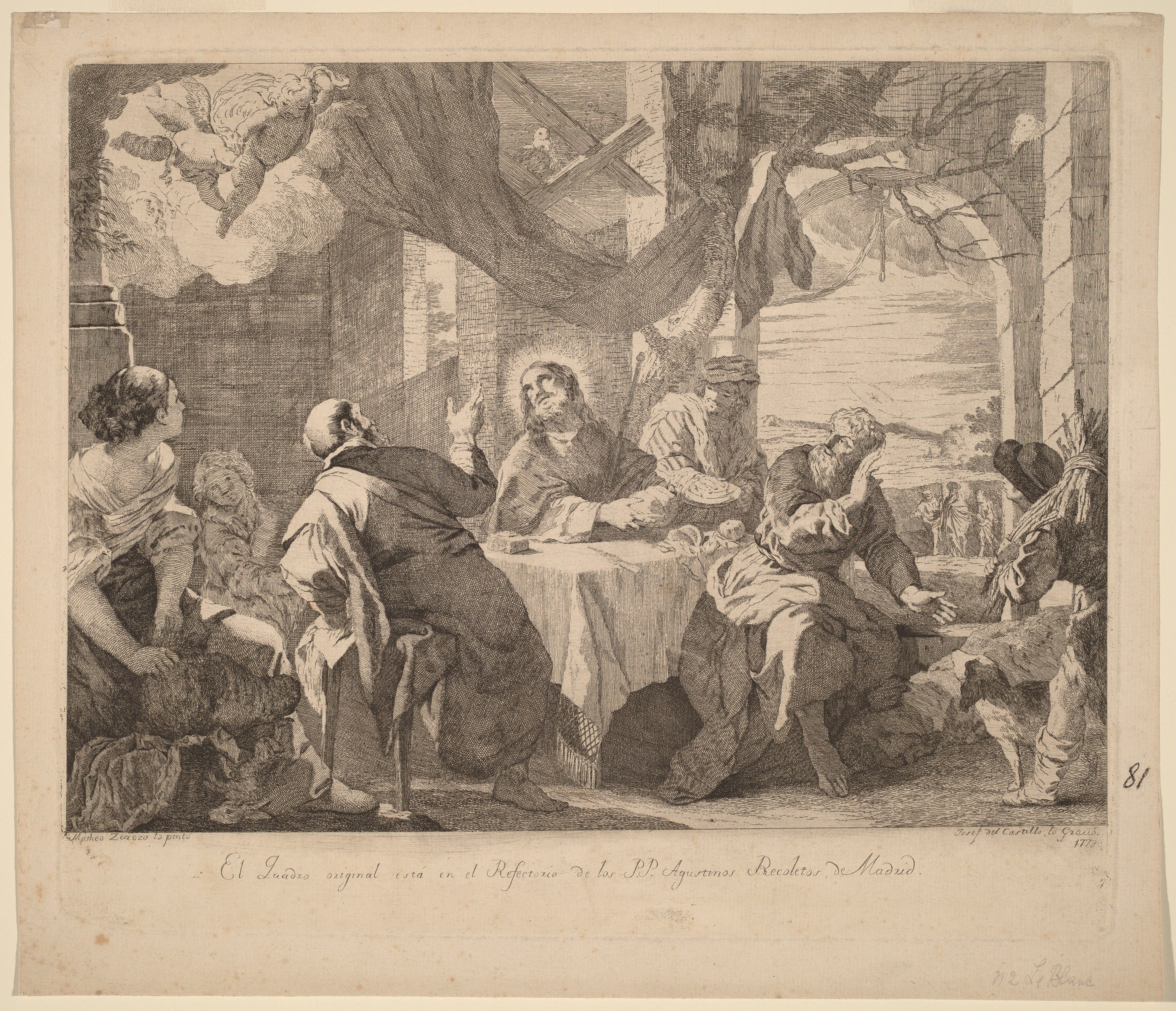
The Supper at Emmaus, José del Castillo, 1778
You can’t see anything properly while your eyes are blurred with tears.
- C.S. Lewis, A Grief Observed
Cleopas and his companion walked from Jerusalem to Emmaus. They were heartbroken as they talked about Jesus’ arrest and crucifixion, and they were confused about the women’s story of angels and the empty tomb. They still hadn’t put the pieces together. They still thought Jesus was a prophet who had come to redeem Israel. They suffered a weight of grief. They had lost the most beloved friend who lived out of the fullness of love and joy.
As they walked, Jesus came alongside them and asked what they were talking about. Luke tells us He found them downcast. In his poem “Emmaus I,” poet Malcolm Guite gives the word nuanced meaning:
And do you ask what I am speaking of

Although you know the whole tale of my heart;

Its longing and its loss, its hopeless love?

You walk beside me now and take my part

As though a stranger, one who doesn’t know

The pit of disappointment, the despair

The jolts and shudders of my letting go,

My aching for the one who isn’t there.
Longing and loss, disappointment and despair are a few of the words that draw us into the disciples’ sorrow. Besides their grief, they must have felt shame, guilt, and regret for all that Jesus suffered. Wouldn’t they have berated themselves for not helping, not standing by Him?
We encounter regret and shame and sorrow on our own road through life. We’re not only crushed by grief and lost in a fog of confusion, but we don’t forgive ourselves for the mistakes we’ve made or the people we’ve hurt.
The poem continues:
And yet you know my darkness from within,

My cry of dereliction is your own,
Guite’s choice of “dereliction” holds a threefold meaning in its sense of abandonment. The disciples felt abandoned by Jesus. But Guite’s disciple is beginning to see that Christ was abandoned by them and by God the Father when bearing the weight of our sins on the cross.
In the poem, the disciple knows it’s Jesus who’s walking beside them. He recognizes that Jesus knows the depths of their pain and the devastation His death has caused. But sense the shift in focus as Jesus talks with them and their hearts burn within them.
You bore the isolation of my sin

Alone, that I need never be alone.
The disciple is realizing that something bigger than loss occurred through Jesus’ suffering and death. Nearing Emmaus, the truth is dawning on the disciples as Jesus uses Scripture to reframe the significance of the cross. As they begin to see God’s plan unfold, their regrets, sorrow, and despair fall away. By the time Jesus breaks bread with them and vanishes, surely with a smile on His face, they know He is the resurrected Christ. Everything changes. They go back to Jerusalem, the memories they fled now transfigured by joy. Jesus pointed to Scripture and changed their view of history’s most catastrophic event in ways they could never have imagined.
Our way back to the road, to where we can see the difficult events of our past with thankfulness and joy, occurs in this same way. God uses the pages of Scripture to show us His plan to redeem our sorrow, mistakes, and regrets. Guite’s poem tells the ending for us:
Now you reveal the meaning of my story

That I, who burn with shame, might blaze with glory.
When we yield the sorrows and regrets we encounter on our road to God, we will begin to see them from His perspective. He sanctifies them by the washing of water with the word, until our hearts burn within us.
“Emmaus I” by Malcolm Guite is used by kind permission of the poet. It can be found in his book Parable and Paradox published by Canterbury Press.
Prayer
— Charles Spurgeon
O Lord, when we look back upon the path
by which Thou hast led us,
our hearts overflow with thankfulness.
For the trials that have tested us,
for the comforts that have cheered us,
for the mercy that has spared us,
we give Thee thanks.
Thou hast turned even our sorrows into instruments of good;
and though we could not see it then,
we see it now —
and we bless Thy holy name.

(Spurgeon’s Prayer of Thanksgiving from Metropolitan Tabernacle Pulpit, Vol. 11)